
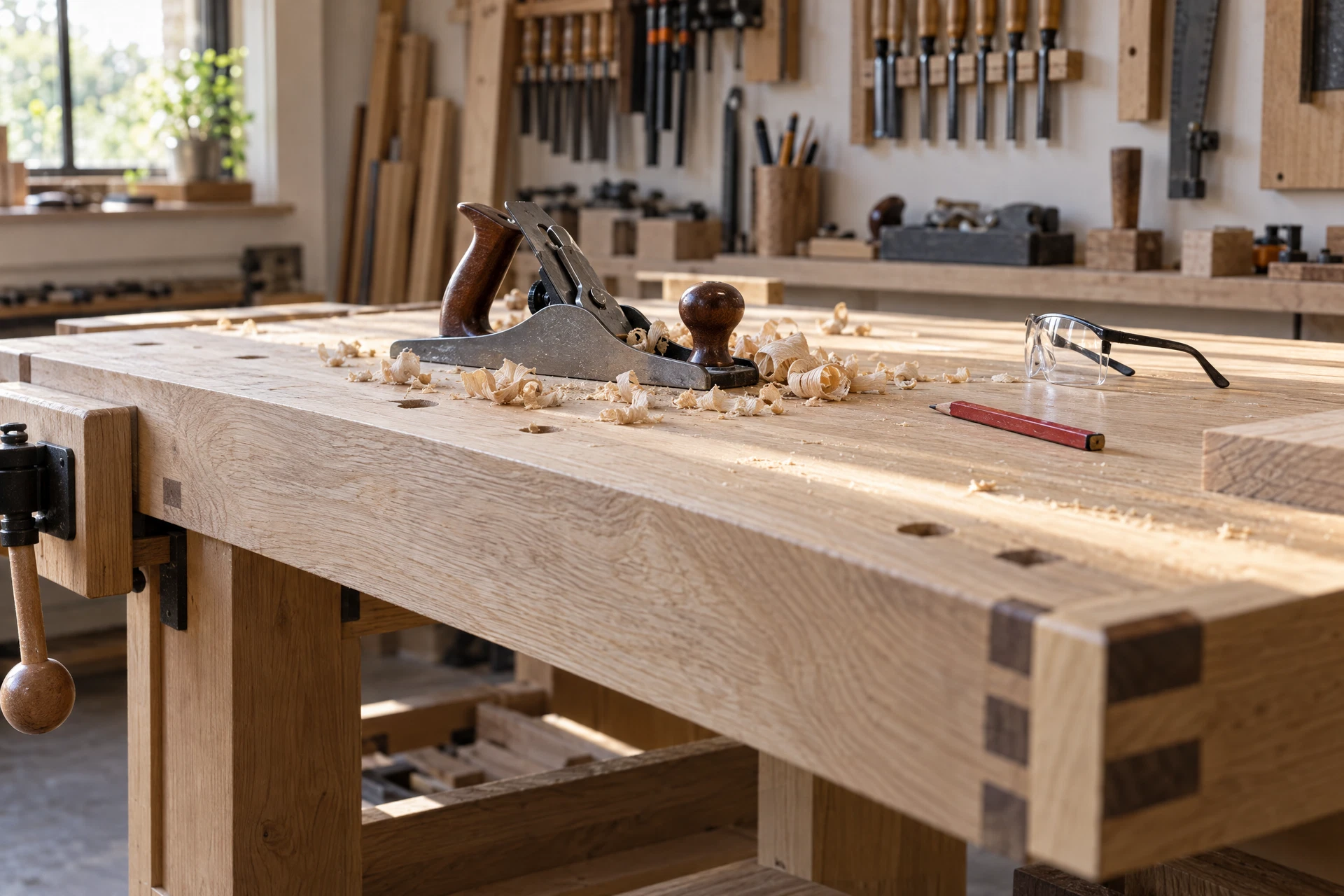
A quick safety note
Woodworking tools and dust can cause serious injury. Use appropriate protection and dust extraction, keep tool guards in place, and get trained help for unfamiliar machinery. Follow a verified full construction plan before building or loading a bench.
Make it fit the way you work
Measure your available space, including room to move around and handle longer boards. Decide what work the bench needs to support before choosing its height, depth, and storage. Mock up the height with an existing surface to see what feels comfortable.
Choose a proven plan
Use a complete, published workbench plan with a cut list, joinery details, bracing, and load guidance. This is a planning primer rather than a dimensional construction plan. A straightforward timber base and replaceable top are often easier to adapt and repair than elaborate cabinetry.
Buy material with the build in mind
Choose straight, dry timber appropriate for the plan. Check actual—not nominal—dimensions before marking cuts. Account for defects, saw kerf, and the fasteners specified by the plan. Reclaimed timber can be useful but must be checked for hidden metal, damage, and hazardous coatings.
Set up for safe, accurate work
Read your tool manuals, secure the workpiece with appropriate clamps, and use eye and hearing protection and suitable dust control. Practice unfamiliar joints on offcuts. Keep guards fitted and do not wear gloves around rotating machinery. Check the finished bench for stability before using it.
Have a question about this topic?
Send us your question or suggest an idea for a future guide.
Talk to The Clever Fix